A light in the storm: the Civil War diary of Amelia Martin by Karen Hesse
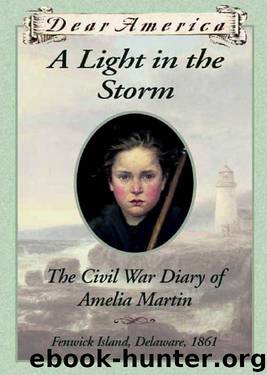
Author:Karen Hesse [Hesse, Karen]
Language: eng
Format: epub
Tags: Fiction, General, Children's Books, Juvenile Fiction, Historical, Diaries, History, General & Literary Fiction, United States, 19th Century, Historical - United States - 19th Century, Ages 9-12 Fiction, People & Places, Children: Grades 4-6, USA, Modern fiction, Civil War, Nature & the Natural World, Slavery, Juvenile Historical Fiction, Civil War Period (1850-1877), Islands, 1861-1865, United States - History - Civil War, Delaware, Lighthouses - Fiction, Delaware - History - Civil War, Islands - Fiction, Lighthouses, 1861-1865 - Juvenile fiction, 1861-1865 - Fiction, Slavery - Fiction, Diaries - Fiction
ISBN: 9780590567336
Publisher: New York : Scholastic, 1999.
Published: 1999-08-31T14:00:00+00:00
Historical Note
h
The tiny state of Delaware occupied an unusual position
during the Civil War: It was officially a slave state, yet its citizens chose not to join the Confederacy. Instead, Delaware remained in the Union and fought with the North. Small as it
was, the state lay on the border between North and South, between freedom and slavery, and those who lived there found
room for disagreement and division among themselves.
The causes of the Civil War date to the founding of the
United States, when Northern and Southern delegates to
the Constitutional Convention disagreed over slavery. The
framers of the Constitution compromised by writing about
slavery without ever using the words slavery or slaves in their
famous document. As a result, the first seventy years of the
new nation were marked by continual tensions and negotiations between North and South, most notably on the question
of whether or not slavery should be permitted in new territories and in new states admitted to the Union. As the North
moved toward industrialization and wage labor, and the South
developed as an agricultural society supported by staple crops
153
and enslaved labor, the clashes between these vastly different
economic systems grew more intense.
When Abraham Lincoln won the presidential election of
1860, Northerners were ecstatic, for they felt certain that
Lincoln would prevent the Southern states from gaining more
power in Congress. The white South, however, reacted to
Lincoln’s election with alarm because Lincoln believed that
slavery should not spread beyond its present borders. Three
months after the election, the seven states of the lower South
voted to secede from the Union — to leave the United States.
These states (South Carolina, Mississippi, Florida, Alabama,
Georgia, Louisiana, and Texas) formed the Confederate States
of America and elected Jefferson Davis as their own president. The Constitution of the Confederacy was similar to the
Constitution of the United States, but with two significant
differences: states’ rights were strengthened, and the institution of slavery was recognized and protected.
At his inauguration in March 1861, Lincoln assured the
white South that he would not attempt to end slavery in states
where it was already legal. Although Lincoln personally judged
slavery to be morally wrong, he did not believe it was his duty
as president to impose those views on others. Lincoln did
make clear, however, that the federal government would enforce the existing laws of the United States, which meant that
154
the South did not have the constitutional right to secede, and
the formation of the Confederacy was considered an act of
treason. At the same time, because Lincoln’s first resolve was to
preserve the Union, he would not go so far as to declare war.
In his inaugural address, he announced to white Southerners,
“In your hands, my dissatisfied fellow countrymen, and not in
mine, is the momentous issue of civil war. . . . You can have no
conflict, without being yourselves the aggressors.”
Fort Sumter, in the harbor of Charleston, South Carolina,
belonged to the federal government. Lincoln had refused to
surrender the fort to the Confederacy, for to do so would have
condoned secession. But by early April, the United States soldiers stationed there were running out of supplies. Sumter
would either have to be resupplied or evacuated. Lincoln made
a
Download
This site does not store any files on its server. We only index and link to content provided by other sites. Please contact the content providers to delete copyright contents if any and email us, we'll remove relevant links or contents immediately.
Among the Betrayed by Margaret Peterson Haddix(11643)
05 Trials of Death by Darren Shan(6477)
Ranger's Apprentice 1 - The Ruins of Gorlan by John Flanagan(5964)
The Power of Now: A Guide to Spiritual Enlightenment by Eckhart Tolle(5856)
Percy Jackson 1 - The Lightning Thief by Riordan Rick(5011)
Suicide Notes by Michael Thomas Ford(4867)
I'm Still Scared by Tomie dePaola(4426)
Pocahontas by Joseph Bruchac(4302)
The Book Thief by Markus Zusak(4201)
The miraculous journey of Edward Tulane by Kate DiCamillo(4160)
07 Hunters of the Dusk by Darren Shan(3787)
The 101 Dalmatians by Dodie Smith(3556)
The Science Book (Big Ideas Simply Explained) by DK(3322)
Harry Potter 4 - Harry Potter and The Goblet of Fire by J.K.Rowling(3134)
Winnie_The_Pooh by A. A. Milne(3078)
The Little Prince by Antoine de Saint-Exupéry(2919)
0041152001443424520 .pdf by Unknown(2892)
The Ring of Sky by Chris Bradford(2868)
The Wrath and the Dawn by Ahdieh Renee(2800)
